How laser engraving works on leatherette hat patches
Short answerA laser engraver focuses a beam of light onto a tiny spot. The material absorbs that energy and the top layer vaporizes where the beam passes, leaving a permanent recessed mark. On leatherette, that exposes the contrasting layer beneath, which is what makes your logo visible.
The short version
Laser engraving is subtractive. The machine does not add ink or thread; it removes a very thin amount of material. A beam of light is focused to a spot much smaller than a pencil point, and where that spot lands the material absorbs the energy as heat. The heat vaporizes a thin layer, and the machine moves the spot along your artwork to draw it into the surface.
Why leatherette engraves so cleanly
Laserable leatherette is built in layers: a thin colored top coat over a contrasting base layer. When the laser removes the top coat in the shape of your logo, the base layer shows through. That is why the result is a tone-on-tone mark with sharp edges rather than a burn mark, and why the same patch can look different with a different color pairing.
The mark is part of the patch. There is nothing on the surface to peel, and no thread to snag.
Vector lines and raster fills
A laser works in two basic ways. It can trace a line, following a vector path from point to point, or it can fill an area by sweeping back and forth in many tight passes, much like a printer head. Most logos use both: outlines and lettering are traced, and solid shapes are filled.
This is why vector artwork (AI, EPS, SVG or PDF) is the preferred file type. Vectors describe shapes with mathematical paths, so the laser can follow them exactly at any size. A low-resolution image has to be converted into paths first, and any blur or jagged edge in the original is carried straight into the engraving.
The settings that matter
Every material needs its own recipe. The main settings are:
- Power: how much energy reaches the material. Too low and the top coat is not fully removed; too high and the base layer is scorched.
- Speed: how quickly the beam moves. Slower speed puts more energy into each spot.
- Focus: the sharpness of the beam at the surface. A well-focused spot gives crisp edges and fine detail.
- Pass count and line spacing: how many times the beam crosses an area and how tightly the fill lines are packed.
From logo to finished hat
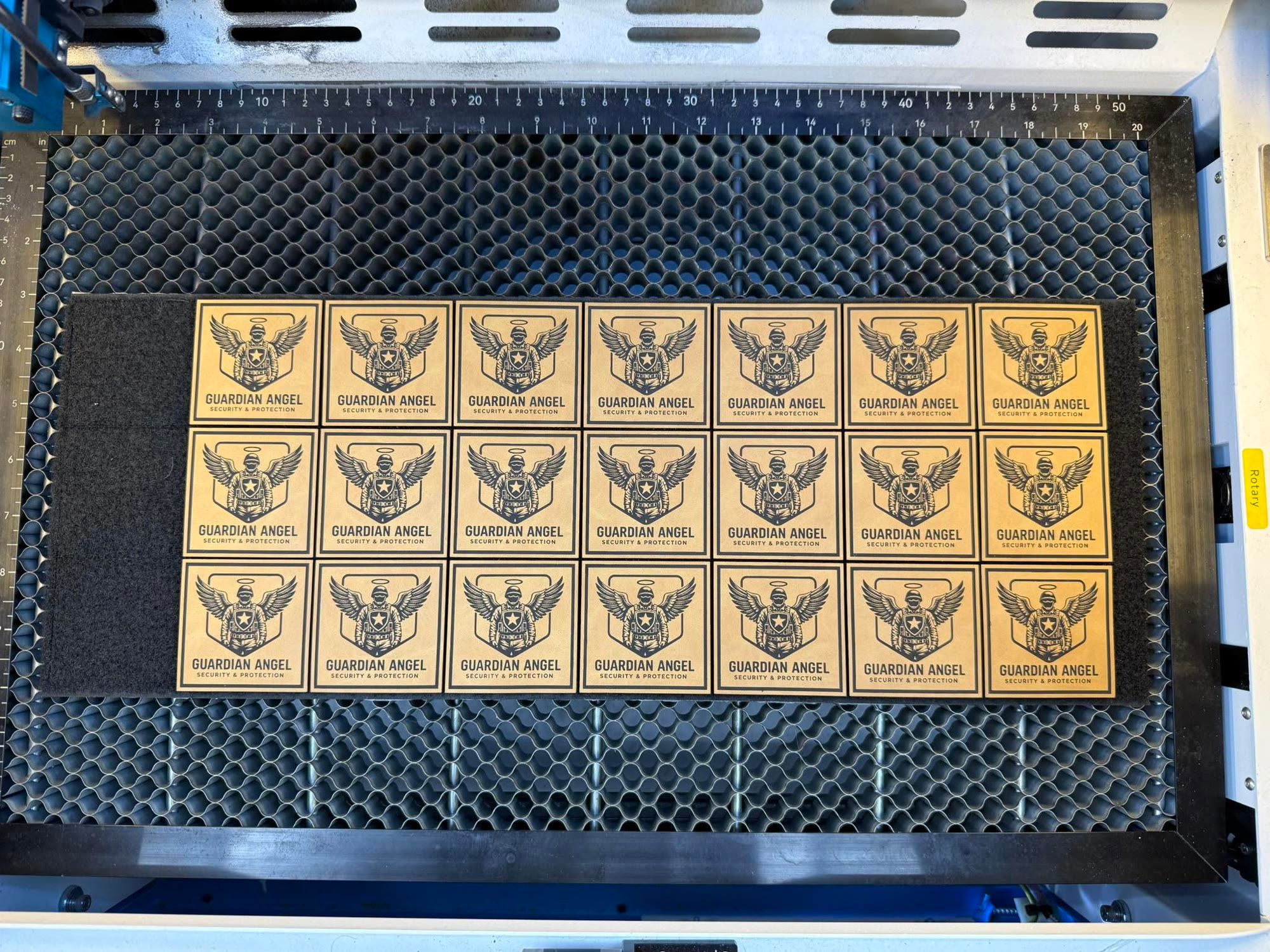
The steps are straightforward. You send a logo and a quantity. We prepare the artwork for the patch and send you a proof, and nothing is engraved until you approve it. Once approved, the patches are engraved, often as a full sheet in a single run, and then cut out to the shape of the design. The patches are applied to the hats, and the order ships.
Because the machine follows a file, repeat orders come out the same every time, which matters when you add new people to the crew next season.
What a laser cannot do
Engraving is a single-tone process on our standard leatherette patch, so a multi-color gradient will be simplified. Very thin lines placed very close together can merge, and tiny text may need to be enlarged. A proof catches all of this before material is committed, and it is the main reason to send us the best version of your artwork you have.
Quick answers
Does laser engraving fade?
Engraved artwork is cut into the patch rather than printed on it, so there is no ink to fade. Like any decorated hat, it should still be handled and cleaned gently.
What file should I send for laser engraving?
A vector file such as AI, EPS, SVG or PDF is best. A high-resolution PNG or JPG also works, and we will tell you if it needs cleanup.
Ready to start? Request a quote with your logo and quantity, or build an estimate first.